Jordan Loewenstein, D.C. | La Jolla Chiropractor
Herniated Disc:
Does It Actually Heal?
Yes, and far more reliably than most people are told when they get the report. The surprising part is that the big, alarming-looking ones disappear the most. Here is what the research shows about how discs resolve on their own, how long it takes, and what to do in the meantime.
Yes — And The Big
Ones Do Better
Pooled across dozens of studies, around 70% of lumbar disc herniations shrink or disappear on their own, without surgery. And the counterintuitive part is the most useful thing on this page: the more dramatically the disc has herniated, the more likely it is to go away.
Two large reviews have put this together — one pulling in 31 studies, one a meta-analysis. Their exact percentages differ slightly. The ordering is identical in every one of them.
| Type on the report | What it means | Chance it resorbs |
|---|---|---|
| Sequestration | A fragment has broken away completely and is sitting free | 88–96% |
| Extrusion | Material has pushed out through the outer ring of the disc | 67–70% |
| Protrusion | A focal bulge, still contained by the outer ring | 38–53% |
| Bulge | The whole disc spreads a little past its normal edge | 13% |
On a phone, scroll the table sideways.
Why Backwards Is Actually Forwards
The mechanism is worth understanding, because it makes the numbers make sense.
A disc that is still contained inside its outer ring has essentially no blood supply reaching it. Nothing can get in to clear it away, which is why a plain bulge mostly just sits there.
The moment disc material breaks through that ring and out into the space around the nerves, the situation reverses completely. It is now sitting in tissue with a blood supply. New vessels grow into it. Immune cells arrive and begin breaking it down — literally consuming it — and the fragment gets smaller month by month.
A report that says “large extrusion” is, in terms of the disc going away, better news than one that says “small bulge”.
That is the opposite of how almost everyone reads their MRI, and it is the single most reassuring fact in this whole area. The piece that broke free is the piece your body can actually get at.
Worth being straight about where these numbers come from. They are pooled from many small studies that scanned people twice and compared the images, not from one enormous trial. The percentages should be read as a strong pattern rather than a precise prediction for you.
But the pattern is consistent across every review that has looked, and it is the reason the standard advice for a disc without warning signs is to give the body a few months before anyone reaches for a scalpel.
How Long, And What
Does Better Feel Like?
Most people with disc-related leg pain are substantially better somewhere between six weeks and four months. Symptoms improve well ahead of the picture — you will usually feel fine long before an MRI would show the fragment gone. Partial or complete shrinkage shows up on repeat scans in around two thirds of people by six months.
Which means you do not need imaging to prove you are healing. The way your symptoms move tells you more, and it tells you sooner.
The leg pain retreats up the leg. This is the big one. Pain that was in your calf moves to the back of the thigh, then to the buttock. That is progress even if the back pain temporarily increases, and it is the sign worth tracking above all others.
You get longer windows without it. Not a lower peak — more gaps. That is usually what improves first.
It takes more to set it off. Early on, ten minutes of sitting does it. Later it takes an hour and a long drive.
Numbness lags behind everything. A patch of numbness or pins and needles is the slowest thing to resolve and can hang around for months after the pain has gone. On its own, that is not a bad sign. Weakness is a different matter — see the red flags below.
Track Where It Ends, Not How Much It Hurts
The single most useful habit while this settles.
Every day, note the furthest point down your leg that you feel anything. Foot, calf, back of the knee, thigh, buttock. That is your marker.
Pain intensity bounces around for all sorts of reasons — sleep, stress, how much you did yesterday — and it is a noisy signal. The distance is much steadier, and it moves in one direction when things are genuinely improving.
Herniation size on MRI correlates surprisingly badly with how much pain someone is in. Where the material sits matters far more than how much of it there is — a small fragment pressed right against a nerve root hurts considerably more than a large one sitting somewhere harmless.
Which is why two people can have near-identical scans and one of them is in agony while the other found out by accident. Do not let a number on a report set your expectations.
Where Chiropractic
Helps
Nothing anyone does makes a fragment dissolve faster — your immune system handles that part on its own timeline. What treatment does is get you through those months without losing ground: finding the movement direction that pulls the leg pain back up, keeping you moving, and settling everything that has tightened up around the problem.
The first job is finding your direction. Most people with a disc problem have one movement that pulls the leg pain up towards the back, and one that drives it further down. Finding which is which changes the whole plan, and it is something an examination finds in a few minutes.
For the majority it is extension — gently arching backwards — but not for everyone, and following the textbook instead of your own response is one of the more common ways people make this worse. Your leg is the referee.
The second job is everything that has tensed up around it. By the time most people come in, weeks of guarding have left the hip, the low back and the whole back of the leg locked down, and a good part of what they are feeling day to day is that rather than the disc. Hands-on soft tissue work makes a fast difference there.
Trials of manual treatment for disc-related leg pain are encouraging and the evidence base is still small — one review found three trials at low risk of bias, all favouring treatment. Realistically it works alongside the natural course rather than replacing it, and the exercises below are the part that keeps the gains.
People often arrive worried that hands-on treatment with a herniated disc is risky. A 2024 study at US academic health centres compared low back pain patients who received chiropractic treatment against those who did not.
Serious nerve compression at the base of the spine occurred in 0.07% of those treated and 0.11% of those not treated — slightly lower in the treated group, and low in both. The fear is not borne out by the numbers.
What matters far more is the screening. Every visit checks reflexes, strength and sensation. If any of the red flags in the next section are present, that is a referral, not a treatment — and knowing the difference is the actual safety measure.
Calm It,
Then Rebuild It
One rule governs everything below: watch your leg. A movement that pulls the pain up towards your back is a movement to do more of, even if your back gets briefly sorer. A movement that drives it further down the leg gets dropped, no matter what it is supposed to do for you. Your leg is the referee, not the instructions.
Tier 1 — Find Your Direction, Calm The Nerve
First two to three weeks, several short sessions a day rather than one long one. Little and often beats a single hard effort with an irritable disc.
 Watch demo
 Watch demo
 Watch demo
 Watch demo
Tier 2 — Rebuild The Support
From week two to three, once the leg pain has started climbing back up. Nothing here should send anything back down the leg.
 Watch demo
 Watch demo
 Watch demo
 Watch demo
 Watch demo
Tier 3 — Load It Again
From around week six, once your leg has been quiet for a while. This is the tier that decides whether this happens again, and it is the one almost everybody skips.
 Watch demo
 Watch demo
 Watch demo
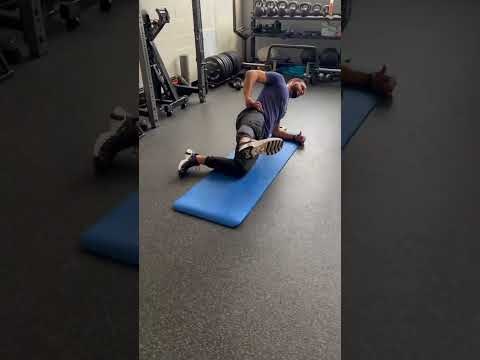 Watch demo
Do This,
Not That
Emergency room, today. Numbness through the saddle area, losing control of your bladder or bowels, trouble starting to urinate, or weakness appearing in both legs. That combination can mean the nerves at the base of the canal are being compressed, and with that one the number of hours genuinely matters.
Seen urgently, not next month. Weakness that is getting worse rather than better — a foot that catches on steps, a leg that gives way, an inability to lift the front of the foot against gravity. Pain almost never requires urgent surgery. Progressive weakness is the finding that can.
Herniated Disc
Questions
Usually, yes. Pooled across dozens of studies, around 70% of lumbar disc herniations shrink or disappear without surgery.
The rate depends on the type. A fragment that has broken completely free resorbs close to 90% of the time, an extrusion around 70%, a contained protrusion roughly 40 to 50%, and a simple bulge only about 13%.
Symptoms usually improve well before the picture does. Most people with disc-related leg pain are substantially better somewhere between six weeks and four months.
On repeat scans, partial or complete shrinkage shows up in about two thirds of people by six months. You will almost certainly feel fine before an MRI would show the fragment gone, which is why re-scanning to check is rarely useful.
For pain in the short term, possibly. For whether it goes away, it is better news — which surprises almost everyone.
A contained bulge has no blood supply reaching it, so nothing can clear it. Once disc material breaks out into the surrounding space it is exposed to blood vessels and immune cells that break it down and carry it away. The piece that escaped is the piece your body can actually get at.
Around nine in ten people with disc-related sciatica never have it. Surgery does give faster relief in the first year or two, and by four to eight years out the gap between operated and non-operated patients narrows considerably.
It also carries a real reoperation rate of about 15% by eight years, mostly for a new herniation at the same level. The situations where surgery is not a matter of preference are the red flags: bladder or bowel changes, saddle numbness, or weakness that is getting worse.
The evidence is reassuring. A 2024 study across US academic health centres found serious nerve compression at the base of the spine occurred in 0.07% of low back pain patients who received chiropractic treatment, against 0.11% of those who did not.
What matters more than the technique is the screening. Reflexes, strength and sensation get checked, and if any red flag is present that is a referral rather than a treatment. Early on the treatment is also gentler than people expect — an irritable disc is not the place for force.
Because the pain is coming from an irritated nerve root rather than from the disc itself. The nerve is being chemically irritated and mechanically compressed where it exits, and it reports pain along everywhere it supplies — which is the leg.
It is also why the direction the pain travels is the best progress marker you have. Pain retreating up the leg means the nerve is calming down, even on days when your back feels sorer.
Rarely worth it if you are improving. The picture lags weeks behind how you feel, and a scan that still shows the herniation does not mean you are not recovering.
A repeat scan earns its place when things are getting worse rather than better, when there is new or progressing weakness, or when you are being assessed for surgery or an injection.
It can, and the biggest thing in your favour is the Tier 3 work. Most recurrences involve the same pattern that caused it in the first place — bending through the spine under load instead of hinging at the hips.
That is exactly what the Romanian deadlift on this page trains, and it is the reason it is worth getting to rather than stopping once the pain has gone. Most people stop at the point their symptoms settle, which is the point the useful part was about to start.
Your Body Is Already
Working On It
The disc resolves on its own timeline. The job in the meantime is finding the direction that settles your leg, keeping the nerve checked, and getting you through the next few months without losing ground. Evening and Sunday appointments available.