Jordan Loewenstein, D.C. | La Jolla Chiropractor
Sciatica &
radiating leg pain
San Diego
Shooting pain, burning numbness, or weakness traveling down your leg — Dr. Jordan Loewenstein identifies the exact nerve root or structure causing your symptoms and treats the source, not just the pain.
Yes, chiropractic care helps most sciatica, which usually comes from a herniated disc or the piriformis muscle compressing the nerve. Dr. Loewenstein pinpoints the true source, then treats it with chiropractic adjustments, flexion-distraction decompression and targeted soft tissue work, matched to what your exam shows. Many patients notice less leg pain within a few weeks; severe nerve cases are referred for medical care.
Where it hurts tells me where to treat
"Sciatica" is a symptom, not a diagnosis. Pain down the leg can come from a disc pressing on a nerve root, from the piriformis muscle in the buttock, the SI joint, the hip, or a stiff facet joint. Each one has its own pattern, and getting the pattern right is what makes treatment work.
- Below the knee into the shin, foot or toes, with numbness or weakness: usually a nerve root, most often L5 or S1 from a disc.
- Deep buttock pain, worse sitting, no real back pain: more often the piriformis.
- Low back and buttock ache that stays above the knee, worse getting out of a chair or car: often the SI joint.
- Groin and front-of-thigh pain, stairs are hard: the hip or an upper lumbar level.
- Both legs tire with walking and ease when you sit: spinal stenosis.
Not sure which is you? Take the two-minute quiz below, or read the full guide to the 13 patterns of leg pain.
How I treat it
The first visit is 45 minutes and most of it is the exam: range of motion, orthopaedic and neurological tests, reflexes, and a look at how your spine and pelvis are sitting. If the exam is clear, treatment starts the same day.
Weeks for mild, months for severe
Either way, the leg pain usually fades before the disc or joint underneath has settled. Finishing the corrective phase is what stops it coming back. I reassess as we go; if nothing has changed after the first few weeks, the plan changes or I refer you on. What the research says about chiropractic vs injections vs surgery →
Which type of leg pain
do you have?
This quiz maps your symptom pattern to the most likely nerve root or structure. It is not a diagnosis — only a thorough clinical exam can confirm the source. Developed by Dr. Jordan Loewenstein based on clinical examination criteria used in practice.
Also treated by
Dr. Jordan Loewenstein
Sciatica rarely exists in isolation — many patients also deal with related spinal or musculoskeletal conditions. Dr. Jordan Loewenstein treats the full spectrum of spinal and nerve-related pain.
Sciatica &
radiating leg pain
FAQs
The 14 most common questions patients ask about sciatica, radiating leg pain, and chiropractic care in San Diego.
Yes — chiropractic care is one of the most well-supported non-surgical treatments for sciatica, particularly when symptoms are caused by a disc herniation, nerve root compression, or spinal joint dysfunction in the lower back. Chiropractors use a combination of spinal manipulation, flexion-distraction decompression, and targeted soft tissue work to reduce pressure on the irritated nerve. Research published in peer-reviewed journals has found that patients receiving chiropractic manipulation for lumbar radiculopathy experience meaningful reductions in pain — and 2025 data shows chiropractic patients also have a significantly lower risk of opioid-related complications compared to medication-only management. Dr. Jordan Loewenstein performs a thorough evaluation to confirm that your leg pain is genuinely coming from the spine (and not from the hip, piriformis, or another source) before beginning any treatment plan. Book at sdspinecare.com.
A pinched nerve — clinically called nerve root compression or radiculopathy — occurs when a spinal disc, bone spur, or tight muscle compresses a nerve exiting the spine, producing pain, numbness, or weakness in the leg. Chiropractic care directly addresses the mechanical causes: adjustments restore normal joint motion and disc alignment, flexion-distraction decompression gently reduces intradiscal pressure and can help a bulging disc retract away from the nerve, and soft tissue work releases surrounding muscular tension. Many patients with confirmed disc herniations on MRI respond very well to chiropractic care and avoid the need for injections or surgery. Schedule an evaluation at sdspinecare.com.
This is one of the most important questions in diagnosing radiating leg pain. True spinal nerve root pain typically follows a predictable dermatomal pattern: it starts in the lower back or buttock, travels in a line down the thigh and into the calf or foot, and is often accompanied by numbness, tingling, or weakness in a specific zone. Non-spinal causes — such as piriformis syndrome, SI joint dysfunction, hip arthritis, or peripheral nerve entrapment — tend to produce pain that is more diffuse, stays above the knee, or is triggered by hip movements rather than spinal loading. Key clinical clues include whether coughing or sneezing worsens the pain (a sign of spinal origin), whether the pattern matches a known dermatome, and whether specific orthopedic tests reproduce symptoms in the spine vs. the hip. You can also take the interactive quiz on this page to get a preliminary sense of your pattern before your visit.
Pain that travels past the knee into the calf, shin, or foot is a sign that a nerve root is significantly irritated — and it does mean the compression is substantial enough to produce symptoms far from the spine. Clinically, this is called "peripheralization" of symptoms. However, this does NOT automatically mean surgery is necessary. Many patients with foot symptoms fully recover with chiropractic care, particularly flexion-distraction decompression, when treatment begins promptly. What matters most is the direction symptoms are moving: if your pain is "centralizing" — the foot pain retreating toward the back as you improve — that is a very favorable prognostic sign. Don't wait — book an evaluation with Dr. Jordan Loewenstein at sdspinecare.com.
Numbness or tingling in the foot is a sign that a sensory nerve fiber is being compressed or irritated. The specific location tells a great deal about which nerve root is involved: numbness on the top of the foot and big toe most commonly points to the L5 nerve root (often compressed by an L4-L5 disc herniation), while numbness at the heel and outer foot is more characteristic of S1 root compression (at L5-S1). If the numbness appears only on the bottom of the foot without any back pain, a peripheral cause such as tarsal tunnel syndrome should be considered. Foot numbness on its own is not an emergency — but if accompanied by weakness in the foot or leg, or any bladder or bowel changes, seek care immediately.
Burning, tingling, or numbness confined to the outer thigh — notably absent from the low back — is the hallmark presentation of meralgia paresthetica, caused by compression of the lateral femoral cutaneous nerve at the inguinal ligament. Unlike true sciatica, meralgia paresthetica involves a purely sensory nerve (no motor involvement, no weakness), and the affected zone is a well-defined patch on the front-outer thigh that doesn't extend to the knee or foot. Common triggers include tight waistbands, heavy tool belts, pregnancy, recent significant weight gain, or prolonged standing. Meralgia paresthetica often responds well to conservative treatment. Dr. Jordan Loewenstein can confirm the diagnosis through clinical examination — book at sdspinecare.com.
Yes — anterior (front of) thigh pain absolutely can originate from the spine. The L2, L3, and L4 nerve roots travel through the femoral nerve and refer pain to the front of the thigh, the inner knee, and the inner shin respectively. A disc herniation at L2-L3 or L3-L4 can cause anterior thigh pain that mimics a quadriceps strain, hip flexor issue, or even hip arthritis. Key questions: does the pain worsen when bending forward or with prolonged sitting? Is there any weakness in the quadriceps or a feeling that the knee might buckle? However, anterior thigh pain can also be caused by hip pathology (labral tear, FAI), femoral nerve entrapment, or other causes — all requiring careful differentiation. Dr. Jordan Loewenstein performs specific clinical tests to distinguish these patterns.
Recovery timelines vary based on how long you've had symptoms, which nerve root is involved, the underlying cause (disc herniation vs. piriformis vs. stenosis), and how far the pain has traveled. For most patients with acute sciatica from a disc herniation — especially when treatment begins within the first few weeks — meaningful improvement is typically seen within 4–8 weeks of consistent chiropractic care. Research shows most patients improve at the 3-month mark, but those receiving early chiropractic care tend to reach improvement faster and with fewer complications. For patients with chronic or long-standing sciatica, or spinal stenosis, the timeline extends and the focus shifts from acute relief to sustained function and symptom management. Dr. Jordan Loewenstein will give you an honest, individualized prognosis based on your specific clinical picture at your first visit.
Yes — when performed by a qualified and experienced chiropractor who has reviewed your case and any relevant imaging, chiropractic care is considered a safe, evidence-based option for lumbar disc herniation with radiculopathy. Flexion-distraction decompression is specifically designed for disc herniations — it gently tractions the lumbar spine in a way that reduces intradiscal pressure and encourages the herniated disc material to retract away from the nerve. High-velocity manipulation at the involved disc level is used selectively and only when clinically appropriate. The research is clear that the majority of disc herniations — even large ones visible on MRI — resolve or reduce significantly without surgery when the underlying mechanical load is addressed. Dr. Jordan Loewenstein reviews all available imaging before beginning care and adjusts techniques accordingly.
Chiropractic addresses the mechanical root cause of nerve compression: restoring motion to the spinal joints, reducing disc bulging through decompression, and releasing soft tissue tension. Epidural steroid injections are anti-inflammatory — they reduce swelling around the nerve root and can dramatically reduce pain in the short term, but do not address the underlying disc or joint pathology causing the compression. Surgery removes or repairs the structural problem but carries procedural risks and a longer recovery. A landmark study found that chiropractic manipulation was nearly as effective as microdiscectomy for sciatica — and patients who tried chiropractic first and eventually needed surgery had the same final outcomes as those who went directly to surgery. Attempting chiropractic first carries no downside. At San Diego Sports and Wellness, Dr. Loewenstein will recommend the appropriate level of care and co-manage with other providers when needed.
Both chiropractors and physical therapists are valuable providers for sciatica, and in many cases the ideal approach involves both. Chiropractors focus on identifying and correcting the joint and disc mechanics compressing the nerve, using spinal manipulation, decompression, and soft tissue techniques. Physical therapists excel at progressive exercise rehabilitation, movement pattern correction, and functional restoration. Research on spinal manipulation plus exercise consistently outperforms either modality alone — which is why Dr. Jordan Loewenstein incorporates rehabilitative exercise guidance alongside hands-on chiropractic treatment in UTC San Diego. If your sciatica has a clear mechanical cause, starting with a chiropractic evaluation makes practical sense, as decompression techniques can rapidly reduce nerve tension before progressing to exercise.
Yes — pregnancy-related sciatica is one of the more common presentations Dr. Jordan Loewenstein treats in UTC San Diego, and chiropractic care can be safely and effectively adapted for pregnant patients at all trimesters. As pregnancy progresses, the growing uterus shifts the center of gravity forward, dramatically increasing the lumbar arch and loading the L4-L5 and L5-S1 discs and sacroiliac joints — the primary sources of sciatica in pregnancy. The hormone relaxin also loosens the pelvic ligaments, which can cause sacroiliac joint instability and referred pain into the posterior thigh. Treatment adaptations include Webster Technique (a specific chiropractic protocol for pelvic alignment in pregnancy), soft tissue release of the piriformis, and gentle mobilization. Meralgia paresthetica — burning outer thigh numbness — is also more common in pregnancy and responds well to conservative chiropractic and postural guidance.
Most leg pain — even severe sciatica — can wait for a scheduled chiropractic evaluation. However, go to the emergency room immediately if you experience: any loss of control of your bladder or bowel; numbness in the saddle region (inner thighs, perineum, genitals, inner buttocks); both legs going weak or numb simultaneously; or severe, constant lower back pain completely unresponsive to any position change and accompanied by fever. These symptoms may indicate cauda equina syndrome — a surgical emergency where the entire bundle of nerve roots at the base of the spine is compressed. The window for surgical intervention that preserves bladder and bowel function is narrow. UCSD Health Emergency Department: (619) 543-6222. For severe bilateral leg weakness or inability to walk, call 911. For all other leg and back pain presentations, the best next step is a thorough evaluation in UTC San Diego.
This is a very common and understandably confusing presentation. A disc can herniate into a nerve root channel and create intense leg symptoms without producing enough local inflammation to register as back pain. Additionally, several non-spinal causes of radiating leg pain involve no spinal component at all: piriformis syndrome compresses the sciatic nerve deep in the buttock; meralgia paresthetica affects the outer thigh nerve at the groin; SI joint dysfunction refers aching into the posterior thigh; and hip pathology can create anterior thigh and groin pain with no back pain whatsoever. The absence of back pain does not mean your leg pain is less serious or that the spine is definitely not involved. This is precisely why a thorough clinical examination matters more than symptom location alone. Dr. Jordan Loewenstein in UTC San Diego takes a systematic approach to identify the true source of leg pain, whether spinal or peripheral.


One doctor.
Every visit.
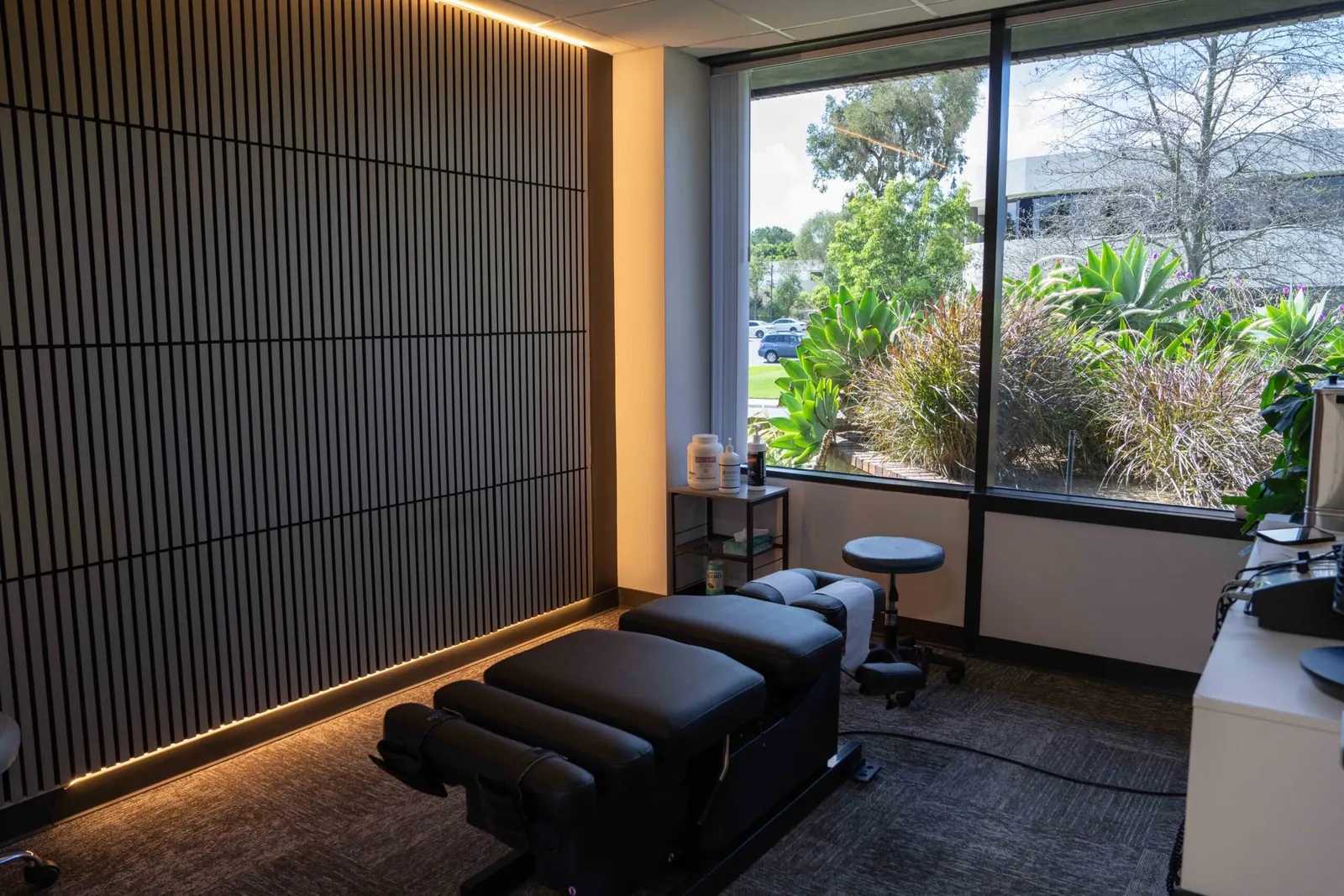
You will see Dr. Jordan Loewenstein at every appointment. Not an associate, not a rotating schedule of providers, not a five-minute pass-through. Forty-five minutes on your first visit, thirty on follow-ups — one-on-one, start to finish.
He holds a Master’s in Nutrition alongside his Doctorate of Chiropractic.

Ready to find out what's
causing your leg pain?
Don't wait for sciatica to progress. Early chiropractic care produces faster, more complete recovery — and starting with chiropractic first carries no downside if other care is eventually needed. Dr. Jordan Loewenstein will identify the exact source and give you an honest prognosis at your first visit.